
Anaglyphs & Stereograms: Introduction
Fall, 2025
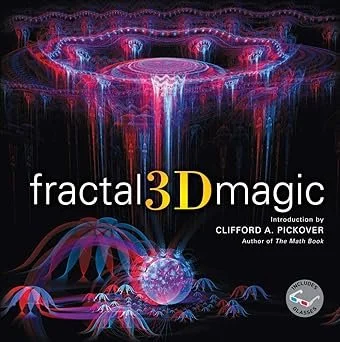
3D for Fun, Not so Much for Profit
This past summer I stayed at a lot of AirBNBs. One of them had this book out as a coffee table book: Fractal 3D Magic by Clifford A. Pickover (2014). I was immediately smitten, then obsessed. By the end of the vacation, I was blind-shooting photo pairs for stereograms with no idea if anything would turn out.
But let me start over. Until recently, I was working on R&D for optics bits for AR/VR/MR/XR headsets. The future of the internet was 3D! we said often then. A few years back, the future of television was 3D. And decades before that, 3D movies were where it was at. The metaverse isn’t the first time the 3D entertainment future didn’t materialize on command, it’s just the most ambitious(ly expensive). Fractal 3D magic, published in 2014, uses the same 3D tricks that the JAWS 3D movie did back in 1983. And this color-split-image 3D is a tech that goes back to the 1920s or before.
So we’re celebrating over a century of 3D entertainment by now, and all we have to show for it is headaches. What gives?
As it turns out, a faux-3D hovering appearance, like the these magic pictures, JAWS 3D or the famous Sea World Pirates 4D experience, can be explained pretty easily by the fact that you have two eyes. Then you just trick those eyes. Fun for a few minutes! Provided you sit still during those minutes.
As the metaverse architects found out, sustaining a truly immersive virtual experience requires tricking more than the eyes, it requires tricking the entire brain. A brain that has evolved very, very carefully to make optimal sense of the absolute firehose of sensory input the world is constantly throwing at us at all times. Tricking the eyes only gets you so far. This is why my VR headset is filled with experiences like “piano playing simulation” and “MMA workout” and “stand here and hit these targets on the beat.” All experiences that are satisfying as I remain largely in one place and never have to turn my head. Games I’ve enjoyed in 2D like Ghostbusters or Exit 8 immediately made me want to throw up when ported over to 3D. The notable thing about user complaints like this for headsets is how universal they are. IMAX gives some people headaches, some users of 3D TVs experienced discomfort, but almost no one can handle a VR game that isn’t specifically calibrated to minimize the discomfort your brain feels trying to cram that almost-3D experience through its processing systems.
Tricking just the eyes, it turns out, is so easy we can do it ourselves right now. I can’t make you a Perception Scientist or a VR games developer in less than a weekend, but I CAN get you up to technical effects assistant 1920-1990 faster than you might think!
In this fall’s collection of projects and demos, we explore anaglyphs (the red/blue 3D craze of the 50s and beyond!) and stereograms. We can trace their history, their pop culture touchstones, and answer two questions: why do we want that immersive 3D entertainment so much, and why can’t we seem to have it?